Tanzania has one of Africa’s youngest populations. Over 67% of its citizens are under 25 years old. Yet youth unemployment remains one of the country’s most urgent crises — with millions of young people lacking the practical skills, networks, and confidence to enter the workforce or start businesses. The good news? Across Tanzania, vocational skills training programmes are proving that this crisis is solvable. This article explores how youth skills training in Tanzania works, what it delivers, and how Changamoto Youth Development Organization has helped over 15,000 young Tanzanians build new futures since 2011.
Tanzania’s education system, despite significant progress, still leaves millions of young people without the practical, vocational, or entrepreneurial skills needed to generate independent income. A secondary school certificate alone does not teach a young person how to manage a beehive, operate a sewing machine, grow organic vegetables for market, or keep financial records for a small business.
This gap between education and employability is at the root of Tanzania’s youth unemployment crisis. And the consequences extend far beyond individual hardship. Youth unemployment drives poverty, rural-to-urban migration, social instability, and environmental degradation — as young people without income are forced into unsustainable natural resource extraction to survive.
67%of Tanzania’s population under 25
15,000+youth empowered by C.Y.D.O since 2011
250+women trained as entrepreneurs through VICOBA
Skills training programmes address this problem directly. By equipping young people with practical, market-relevant skills — and pairing those skills with business development support, mentorship, and access to micro-finance — these programmes can transform a young person’s economic trajectory within months, not years.
There is a wide spectrum of youth vocational programmes operating across Tanzania — from formal government VETA (Vocational Education and Training Authority) institutions to community-based NGO programmes. The most impactful programmes share several characteristics: they are rooted in local economic realities, they teach practical skills that can generate immediate income, and they connect youth with ongoing support networks after training ends.
C.Y.D.O’s Youth Skills and Training programme in Lushoto, Tanga, is built on exactly this model. Since 2011, the organisation has delivered skills training across a diverse range of disciplines — selected specifically because they align with Tanzania’s economic opportunities and environmental priorities.
Sustainable Agriculture and Organic Farming
Tanzania’s economy is fundamentally agricultural. Approximately 65% of the working population is employed in agriculture, and yet smallholder farm productivity remains far below potential. C.Y.D.O’s sustainable farming training equips youth with organic farming techniques, soil management, composting, water-efficient irrigation, and market-ready crop selection — transforming subsistence farmers into small-scale agricultural entrepreneurs.
Youth who complete agricultural training through C.Y.D.O don’t just grow food for their families — they grow surpluses for local markets, reduce their households’ spending on food, and in many cases, go on to train other farmers in their communities. The multiplier effect is significant.
Tree Nursery Management and Environmental Skills
One of C.Y.D.O’s most innovative contributions to Tanzania’s skills landscape is training young people as professional tree nursery managers and environmental restoration technicians. This directly integrates youth employment with C.Y.D.O’s reforestation mission — creating a pipeline of trained young Tanzanians who can manage nurseries, execute planting programmes, conduct ecological surveys, and lead community conservation education.
Tree nursery management is a genuine, marketable profession in Tanzania. As government and NGO reforestation projects scale up, the demand for trained nursery professionals is growing rapidly. Youth trained in this field by C.Y.D.O have gone on to establish their own commercial nurseries, supplying seedlings to both local communities and larger restoration projects.
VICOBA: Financial Skills for Women Entrepreneurs
The Village Community Banks (VICOBA) programme has been one of C.Y.D.O’s most transformative youth empowerment initiatives. Through VICOBA, over 250 women in Tanzania’s Tanga region have been trained in financial literacy, group savings, micro-lending, business plan development, and cooperative enterprise management.
The results have been remarkable. Women who complete VICOBA training typically start or significantly expand small businesses within six months. They access credit through their savings groups — eliminating the need for formal bank loans that remain out of reach for most rural Tanzanians. And they build networks of mutual support and accountability that extend far beyond the training itself.
✨ A Story From the Ground: From Training to Business Owner
Fatuma came to C.Y.D.O’s VICOBA programme in 2022 as a young mother with no formal income. Her husband’s fishing income was irregular, and food security for her children was a constant worry. After completing the 12-week financial skills training, Fatuma joined a savings group with six other women from her village. Within three months, she had accessed her first small loan from the group’s collective savings. She used it to purchase wholesale soap and cleaning products, which she sells through a small community kiosk. Today, Fatuma’s business turns over a consistent monthly profit — and she is now mentoring a new cohort of VICOBA participants. “I didn’t need charity,” she says. “I needed skills and a little trust.”
Vocational Skills for Youth Across Sectors
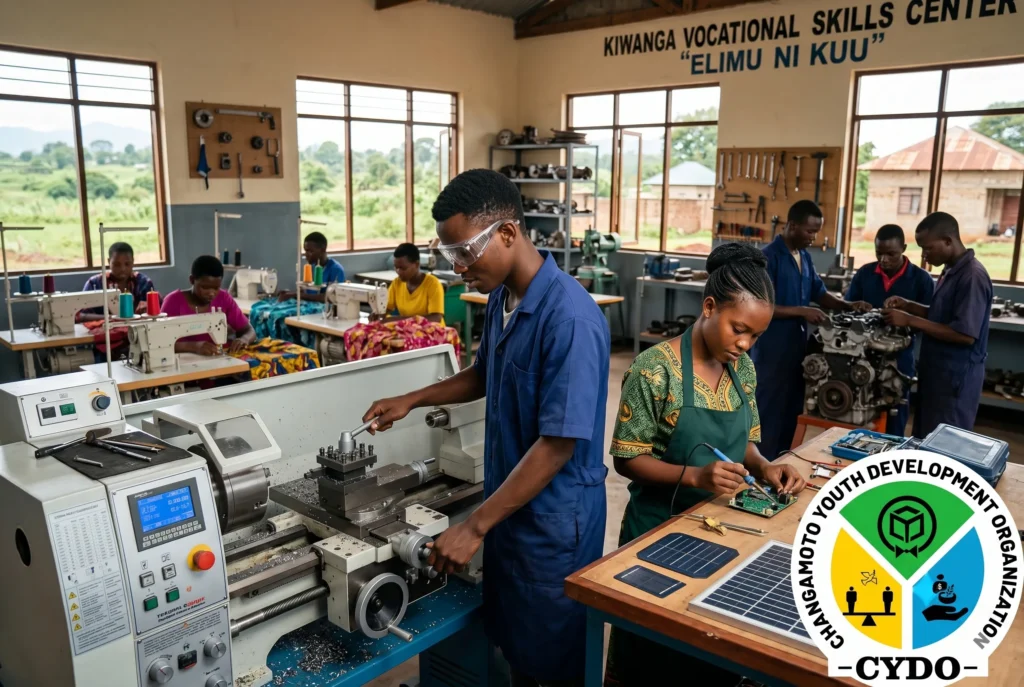
Beyond agriculture, environmental skills, and financial literacy, C.Y.D.O delivers vocational training in a range of additional sectors based on local market demand. These include tailoring and textile production, carpentry and construction skills, beekeeping and honey production, ICT and digital literacy, and school-based environmental education and leadership programmes.
All of C.Y.D.O’s vocational programmes follow the same foundational philosophy: skills training is only the beginning. What creates lasting economic change is connecting newly skilled youth with markets, mentors, peer networks, and — where appropriate — micro-finance that allows them to put their skills to work immediately after training ends.
How C.Y.D.O's Skills Training Creates Lasting Change
The impact of C.Y.D.O’s youth skills training extends well beyond individual graduates. When a young person gains skills and starts earning income, the effects ripple outward through their family, their community, and their environment.
- Family food security improves — trained farmers produce more food. Trained entrepreneurs generate income that feeds families consistently, regardless of seasonal agricultural cycles.
- Children stay in school — when parents have stable income, they can afford school fees, uniforms, and books. C.Y.D.O has documented strong correlations between youth training programme completion and improved school enrolment among graduates’ children.
- Environmental pressure reduces — youth with skills and income do not need to cut trees for charcoal or overfish local rivers to survive. Skills training and environmental conservation are deeply connected.
- Communities become training hubs — C.Y.D.O’s most successful graduates frequently become informal trainers themselves, sharing skills with neighbours, family members, and community organisations. Knowledge spreads organically in ways that formal programmes never can replicate.
The Role of Partnerships in Scaling Youth Skills Training
C.Y.D.O does not work alone. Tanzania’s youth skills challenge is too large for any single organisation to solve. Effective youth training programmes require partnerships across government, civil society, the private sector, and international development organisations.
C.Y.D.O actively partners with local government authorities in Lushoto and Tanga, with Tanzania’s formal education system to align training with curriculum where possible, with businesses and cooperatives that can absorb trained graduates, and with international donors and development organisations that provide financial support for programme delivery.
Businesses, in particular, have a critical role to play. Companies operating in Tanzania — in agriculture, construction, hospitality, conservation, and manufacturing — benefit directly from the pipeline of skilled young workers that C.Y.D.O and similar organisations create. Corporate partnerships that fund skills training are not charity: they are investments in the human capital that the Tanzanian economy needs to grow.
What the Next Generation of Youth Skills Training Looks Like
As Tanzania’s economy evolves and the global demand for sustainability-linked skills grows, C.Y.D.O is continuously expanding and adapting its training programmes. Emerging focus areas include renewable energy installation and maintenance, sustainable tourism and eco-guiding, digital entrepreneurship and social media for small business, and advanced environmental monitoring and conservation science.
The common thread across all of these areas is the same principle that has driven C.Y.D.O’s work since 2011: Tanzania’s young people are not the country’s problem. They are its solution. Given the right skills, support, and opportunities, they will build the businesses, protect the forests, and lead the communities that create the Tanzania they deserve.
Help Us Train the Next 15,000
C.Y.D.O has transformed 15,000 lives through skills training. With your support — as a donor, volunteer, or partner — we can reach the next 15,000 young Tanzanians waiting for their chance.
Frequently Asked Questions (FAQs)