The idea of planting trees in Africa sounds powerful. But the reality of finding a trustworthy, transparent, community-rooted organisation to do it with is harder than it should be. The internet is full of “volunteer abroad” programmes that promise life-changing environmental work and deliver a few hours of landscaping surrounded by other tourists. This article is for people who want something different — real reforestation work, with a real community, in one of Tanzania’s most ecologically critical landscapes. Here is everything you need to know about volunteering to plant trees in Tanzania with C.Y.D.O.
Tanzania’s forests are in crisis. The country loses more than 400,000 hectares of forest every year to charcoal production, agricultural expansion, and unregulated timber harvesting. In the Eastern Arc Mountains — which include the Usambara Mountains in Tanzania’s Tanga Region — deforestation threatens one of the planet’s most unique and irreplaceable concentrations of endemic species.
The scale of what needs to be restored vastly exceeds what any organisation can fund through paid staff alone. Volunteers fill a critical gap — providing additional planting capacity during key windows, bringing skills that complement local expertise, and contributing financially through programme fees that fund seedlings, tools, and operational costs for months after they leave.
500,000+native trees planted by C.Y.D.O
400,000 haTanzania forest lost per year
3 active reforestation project sites
When you volunteer to plant trees in Tanzania with C.Y.D.O, you are not a tourist. You are a genuine participant in restoration work that will outlast your visit by decades — possibly centuries.
Let’s be specific about what you will actually do. C.Y.D. O’s reforestation volunteer programme is built around the full restoration cycle — not just the planting day photo opportunity.
Phase 1: The Tree Nursery — Where Restoration Really Begins
Before a single tree goes into the ground in a forest, it spends weeks or months in C.Y.D. O’s tree nurseries. Volunteers in the nursery phase work on seed collection from healthy indigenous mother trees, seed pre-treatment (scarification, soaking) to break dormancy, germination medium preparation, potting into individual grow-bags, daily watering and care, pest and disease monitoring, and seedling labelling and record keeping.
Nursery work is detailed, rewarding, and genuinely skilled. Within a week, most volunteers can identify twenty or thirty native Tanzanian tree species by their seedling leaves, know which species need full sun versus shade for germination, and understand the micro-decisions that determine whether a seedling becomes a forest giant or a casualty.
Phase 2: Site Preparation — Reading the Land
Before seedlings leave the nursery, C.Y.D. O’s teams prepare the planting sites. Volunteers participate in hole digging at the correct spacing and depth, soil assessment and amendment where necessary, placement of thorn-branch protective barriers against browsing animals, and site mapping for GPS monitoring records.
This is hard, physical, outdoor work. It is also where you begin to develop a visceral understanding of what forest restoration actually demands — the labour, the knowledge, and the long-term commitment that no drone shot of a planting day can communicate.
Phase 3: Planting Days — The Moment That Lasts
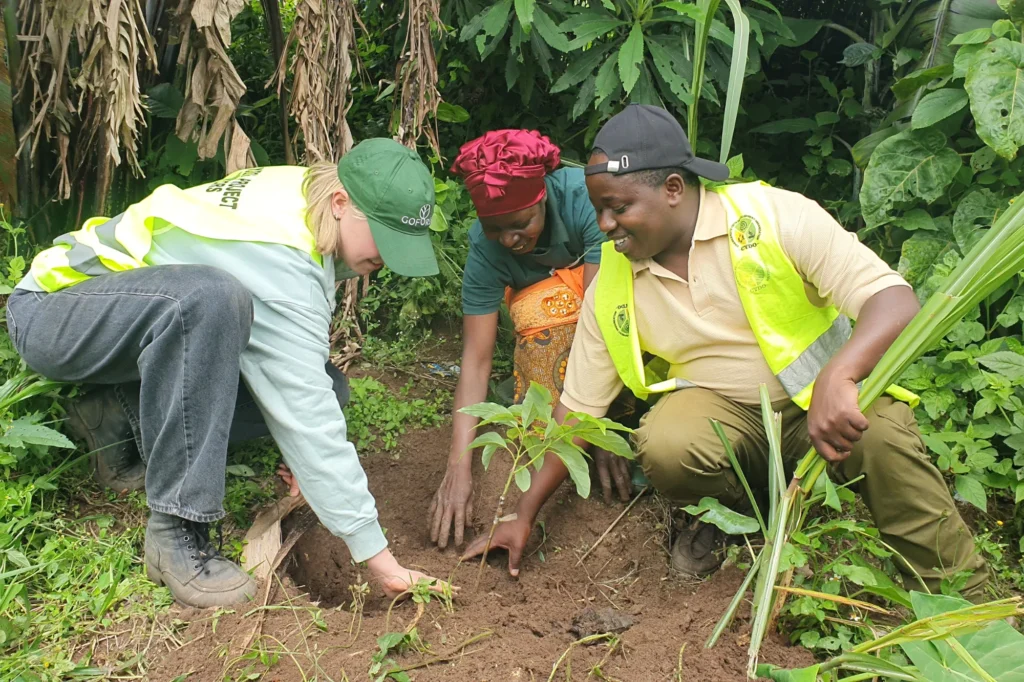
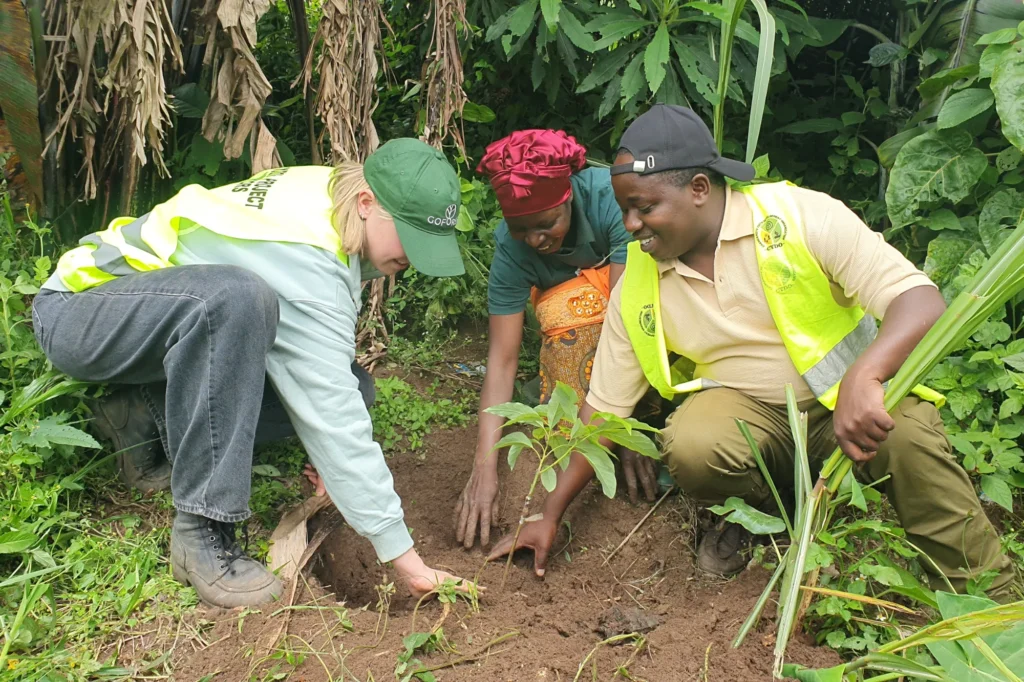
Planting days at C.Y.D.O project sites in the Shagayu Forest Reserve, the Pangani River Basin, and the Tanga Coast mangrove sites are long, communal, and deeply satisfying. Teams of C.Y.D.O youth, community members, and volunteers work together across the site from early morning — planting, staking, mulching, and watering each seedling before moving to the next.
Every tree planted at C.Y.D.O project sites receives a GPS coordinate record. Volunteers can look up the exact location of every tree they planted — and donors who fund trees receive those coordinates in their impact reports. It is one of the most concrete and verifiable forms of environmental action available anywhere in the world.
Phase 4: Post-Planting Monitoring and Care
The planting day is the beginning, not the end. Volunteers who stay for two weeks or longer participate in post-planting survival surveys — revisiting planted areas to assess survival rates, water struggling trees, replace casualties, and record data that informs future planting decisions. This monitoring phase is where volunteers often develop the deepest appreciation for what restoration requires — patience, detail, and commitment that extends far beyond any single visit.
C.Y.D. O’s Three Active Reforestation Project Sites
C.Y.D.O currently operates reforestation volunteer placements across three geographically distinct and ecologically important project sites. Most volunteers who stay for three weeks or more have the opportunity to work at more than one.
Shagayu Forest Reserve — Usambara Mountains
The Shagayu Forest Reserve in the Western Usambara Mountains is one of the most biodiverse and endangered forest reserves in Tanzania. C.Y.D. O’s Shagayu Forest Revival project is planting 50,000 indigenous trees including African Cherry, Wild Fig, African Mahogany, and endemic Usambara species within and around the reserve’s buffer zones. Volunteers at Shagayu work in genuinely wild, spectacular mountain forest — an experience unlike any conventional volunteer programme.
Pangani River Basin — Riverine Restoration
The Pangani River is one of Tanzania’s most important water systems, supporting over five million people. Decades of deforestation along its banks have destabilised watersheds and reduced dry-season water flows. C.Y.D. O’s Pangani River Basin Restoration project is planting over 500,000 native trees along the river’s riparian corridors — restoring the natural “green infrastructure” that regulates water flow and prevents catastrophic soil erosion. Volunteers here work in a landscape that feels genuinely urgent — because it is.
Tanga Coast — Indian Ocean Mangrove Restoration
Tanzania’s coastal mangrove forests have been severely degraded by charcoal cutting and shrimp pond development. Mangroves are climate superheros — storing carbon at three to five times the rate of tropical forests — and provide critical nursery habitat for fish that feed coastal communities. C.Y.D. O’s Indian Ocean Mangrove The planting project on the Tanga Coast involves volunteers in the physically unique experience of planting trees in tidal zones — work that combines ecological importance with a remarkable natural setting.
What Makes C.Y.D.O a Real NGO Worth Volunteering With?
This question matters more than it might seem. The “volunteer tourism” industry includes organisations that provide feel-good experiences with minimal genuine impact — sometimes actively harmful to communities and the environments they claim to restore. Here is why C.Y.D.O is different.
- Registered and transparent: C.Y.D.O is registered with Tanzania’s NGO Coordination Board (Reg. #21NGO/0004747) and TIN 118-511-379. Full documentation available on request.
- Community-led from the beginning: C.Y.D.O was founded by Tanzanians in 2011 and is led and staffed primarily by local community members. Volunteers support the mission — they do not replace local workers or expertise.
- GPS-verified outcomes: Every tree planted is GPS-recorded. Donors and volunteers can verify exactly what was planted, where, and when. This is rare in the sector.
- 14 years of documented impact: 15,000+ youth empowered, 500+ projects completed, 500,000+ trees planted. This is not a new operation — it is an established, proven organization with a long track record.
- No “voluntourism” shortcuts: C.Y.D.O designs volunteer programmes around genuine project needs, not volunteer entertainment. You will do real work — sometimes unglamorous, always meaningful.
💬 What Volunteers Say
“I’ve planted trees in three countries. What C.Y.D.O does is different. The nursery work, the GPS recording, the community integration — this is what actual reforestation looks like. I left knowing my trees will still be there in 50 years because the community that planted them alongside me will protect them.”
— Robert, USA, 4-week environmental volunteer
C.Y.D. O’s tree planting volunteer programme is open to people without specialized environmental or botanical knowledge. The skills that matter most are very different from what most people expect.
- Physical fitness and willingness to work outdoors: Planting days are physical, often under the sun or in the rain. You do not need to be an athlete, but you need to be comfortable with sustained physical work.
- Patience and attention to detail: Nursery work rewards careful, attentive workers. The volunteers who thrive are the ones who notice which seedlings are struggling before the problem becomes critical.
- Curiosity and respect: A genuine interest in learning from Tanzanian colleagues — about the trees, the land, the community, and the challenges of restoration — makes the difference between a good volunteer and a great one.
- Specialist knowledge that is genuinely useful: Ecology, botany, hydrology, conservation biology, forestry, photography, data management, community development. All of these add specific value, and C.Y.D.O will design your programme to use them.
- Email C.Y.D.O at info@changamotoyouth.org. Include your name, nationality, available dates, interest in the reforestation programme specifically, and a brief note about your background and motivation.
- Receive your programme proposal— C.Y.D.O will respond within 2–3 working days with a tailored programme outline, fee schedule, and accommodation options.
- Confirm your placement by paying a deposit. C.Y.D.O will then begin preparing your specific project assignments and accommodation.
- Complete your pre-arrival preparation— health preparations, visa, travel insurance, and packing using C.Y.D.O’s detailed pre-arrival guide.
- Arrive in Lushoto and begin. C.Y.D.O’s team meets you, orients you, and puts you to work. Your trees are waiting.
Your Trees Are Already Growing. Come Plant More.
C.Y.D. O’s reforestation projects in the Usambara Mountains, the Pangani River Basin, and the Tanga Coast need hands, commitment, and people who believe that what they do with a week or a month can matter for a century. That person could be you.
C.Y.D.O | info@changamotoyouth.org | +255 718033646 | Lushoto, Tanga, Tanzania
Frequently Asked Questions (FAQs)