Skills training without a path to income is just education. What Tanzania’s unemployed youth need is not just knowledge — they need the tools, connections, and confidence to convert that knowledge into livelihoods. That is precisely what makes C.Y.D.O’s approach different. Since 2011, the organization has not just trained young Tanzanians — it has walked with them from training room to marketplace, from first harvest to first profit, from uncertainty to self-reliance. This article documents the practical, real-world ways C.Y.D.O turns skills into income for unemployed youth across Tanzania’s Tanga region.
Across Africa, millions of young people complete vocational training programmes each year — and then return to unemployment. The reason is rarely a lack of skill. More often, it is a lack of the surrounding infrastructure that turns skills into income: access to starter capital, markets for their products, business management knowledge, mentorship from experienced practitioners, and networks of peers and supporters.
A young woman trained in tailoring needs a sewing machine before she can earn a single shilling. A trained farmer needs seeds, fertilizer, and water access before the first crop. A trained beekeeper needs hives before there is any honey to sell. Skills training that stops at the classroom door fails the very people it was designed to help.
C.Y.D.O’s programs are built around a simple but powerful insight: the gap between trained and employed is bridgeable — but only if organizations commit to crossing it alongside the youth they serve.
Every C.Y.D.O. skills programme begins not in the classroom but in the marketplace. Before launching any training cohort, the organization assesses local economic conditions: What skills are in demand? What products and services can be sold locally? What existing resources — land, water, raw materials — can trained youth leverage immediately after graduation?
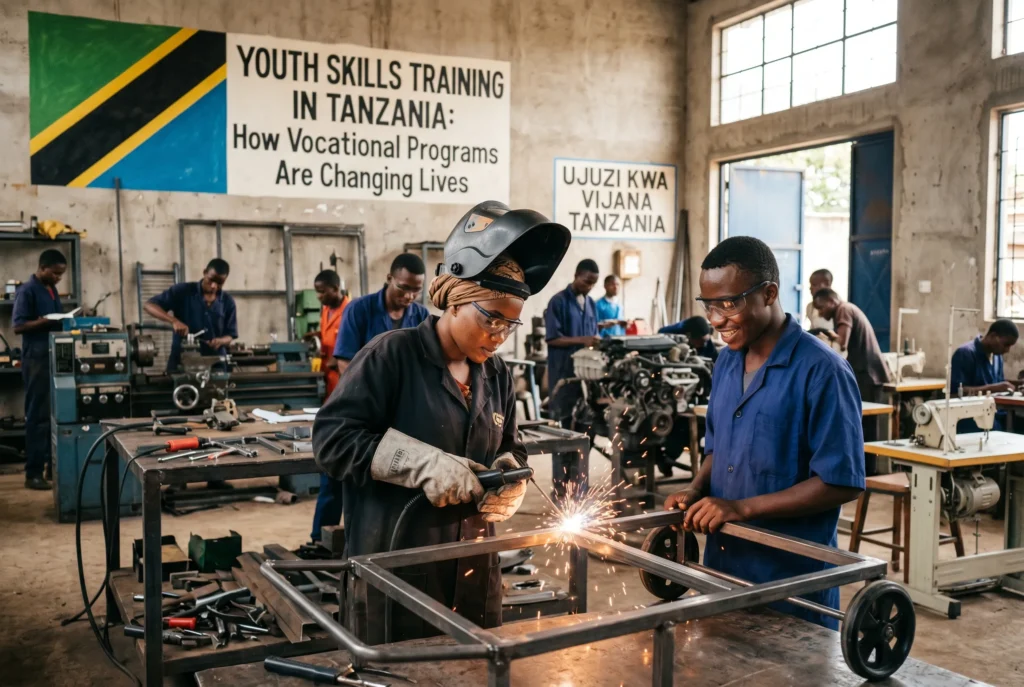
This market-first approach means that C.Y.D.O graduates are not trained in theoretical skills that have no local application. They are trained in competencies that have immediate, documented income potential in Tanzania’s Tanga region specifically.
- Sustainable agriculture: Matched to local food markets, hotel and lodge supply chains, and export opportunities for high-value organic produce.
- Tree nursery management: Matched to growing demand from government and NGO reforestation programmes across Tanzania.
- VICOBA financial skills: Matched to the reality that formal bank credit is inaccessible for most rural Tanzanians — group savings models fill this gap immediately.
- Beekeeping: Matched to Tanzania’s rich honey market and the Usambara Mountains’ extraordinary floral diversity, which produces premium-quality honey that commands high prices.
- Tailoring and textiles: Matched to local clothing markets, school uniform contracts, and growing demand for locally produced fabric goods.
C.Y.D.O’s most distinctive contribution to Tanzania’s youth skills landscape is what happens after training ends. Rather than declaring success at graduation, the organization provides structured post-training business development support to help graduates move from being trained to earning.
Business Plan Development
Every graduating youth is supported in developing a simple, practical business plan. Not an MBA-level financial model — a realistic, one-page roadmap that answers the essential questions: What will I produce? Who will buy it? What do I need to start? How will I price it? How will I manage my money? This simple planning process dramatically increases the probability that a trained youth will take action rather than waiting for conditions to improve.
Access to Starter Resources
Where possible, C.Y.D.O connects graduates with starter resources — not as handouts, but as investments recoverable through small repayments once income begins. These may include seedling packs for agricultural graduates, basic tools for artisanal skills graduates, or hive starter kits for beekeeping graduates. This removes the most common barrier to self-employment: the initial capital requirement.
VICOBA Micro-Finance Groups
The VICOBA (Village Community Banks) model is one of C.Y.D.O’s most powerful tools for connecting skills to income. Graduates who join VICOBA savings groups gain access to small, rotating loans from their group’s pooled savings — without needing formal credit history, collateral, or bank account access.
Over 250 women in Tanzania’s Tanga region have accessed capital through C.Y.D.O’s VICOBA groups. The average loan size is small by international standards — but in the context of rural Tanzania, even a loan equivalent to $30–50 can provide the initial capital to launch a small trading business, purchase agricultural inputs, or buy raw materials for a tailoring enterprise.
💛 Real Story: John’s Journey from Training to Tree Nursery Business
John joined C.Y.D.O’s tree nursery management training programme in Lushoto in 2021. Before the programme, he had completed secondary school but had no income and no clear path forward. After eight weeks of training, John established a small tree nursery on a quarter-acre plot of family land. Within his first planting season, he sold 2,000 seedlings to a C.Y.D.O reforestation project and 800 more to local farmers replanting degraded farmland. By the end of his first full year in business, John was earning more than the average Tanzanian civil servant’s salary — from a business he owned entirely himself. He has since employed two other young men from his village as nursery assistants.
Step 3: Market Connections and Sales Support
Having a skill and having a market are two different things. C.Y.D.O actively works to connect graduates with buyers — creating direct pipelines between trained youth producers and the customers, businesses, and institutions that need what they produce.
- Agricultural graduates are connected with local hotels, lodges, schools, and food traders who need reliable supplies of organic vegetables, fruit, and honey.
- Tree nursery graduates receive priority as seedling suppliers for C.Y.D.O’s own reforestation projects and are introduced to government and NGO buyers across the region.
- Tailoring graduates are supported to pursue contracts for school uniforms, NGO staff uniforms, and community group clothing orders.
- VICOBA graduates are supported to formalise their savings groups, open group bank accounts, and access the next tier of micro-finance as their businesses grow.
Step 4: Long-Term Mentorship and Peer Networks
The final — and often most underestimated — element of C.Y.D.O’s skills-to-income model is the peer network that forms around each cohort of graduates. Young entrepreneurs learn fastest from other young entrepreneurs who have faced the same challenges, solved the same problems, and built businesses in the same communities.
C.Y.D.O graduates become part of a growing network of over 15,000 trained youth across the Tanga region. This network meets formally through alumni events and informally through daily life — providing a web of practical support, referrals, shared resources, and mutual accountability that extends C.Y.D.O’s impact far beyond the organisation’s direct capacity.
The Numbers Behind the Mission
Impact at C.Y.D.O is not anecdotal. The organisation tracks outcomes systematically, using regular follow-up surveys with graduates to document income changes, business survival rates, employment creation, and broader community impacts.
15,000+youth empowered since 2011
250+women entrepreneurs trained
500+community projects completed
25+ communities served
Behind each of these numbers is a story like John’s, or Fatuma’s — a young Tanzanian who arrived with potential but without a path, and left with both. That is what C.Y.D.O’s skills-to-income model delivers. Not charity. Not dependency. Capability.
Frequently Asked Questions (FAQs)