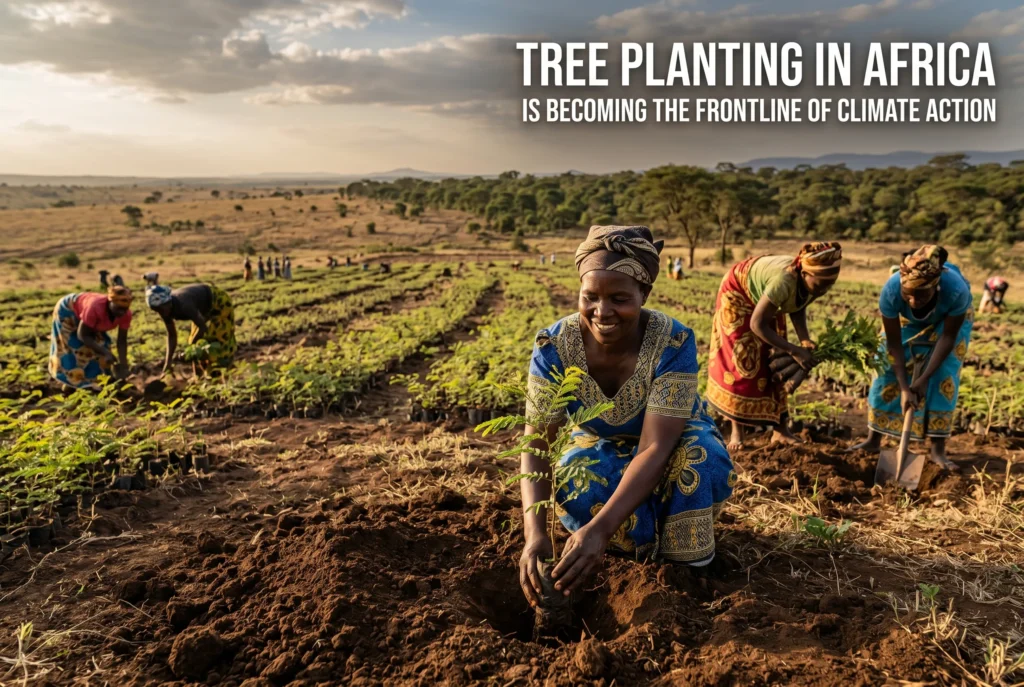
Climate scientists agree: forests are among our most powerful tools against climate change. And Africa — home to the Congo Basin, the world’s second-largest tropical rainforest, and some of the planet’s most biodiverse woodland ecosystems — sits at the very centre of this battle. Across the continent, grassroots organisations, communities, and young people are leading a quiet revolution. Here in Tanzania, that revolution has a name: reforestation. This article explores how tree planting across Africa, and specifically in Tanzania, is emerging as one of the most cost-effective, community-driven climate solutions on earth.
Africa's Forests: The Climate Stakes Are Enormous
Africa contains approximately 25% of the world’s tropical forests. These forests absorb hundreds of millions of tonnes of carbon dioxide every year, regulate rainfall patterns across entire subcontinents, and support hundreds of millions of people who depend directly on forest resources for food, water, medicine, and income.
But Africa is also losing its forests faster than almost anywhere else on earth. Sub-Saharan Africa accounts for roughly 34% of global tropical deforestation. In Tanzania alone, forests are disappearing at a rate of over 400,000 hectares per year — driven by charcoal production, agricultural expansion, and unregulated timber extraction.
34%of global tropical deforestation in Sub-Saharan Africa
25%of world’s tropical forests in Africa
400,000 halost per year in Tanzania
The consequence is a self-reinforcing crisis: fewer trees mean less rainfall. Less rainfall means more drought and crop failure. More crop failure means more poverty-driven deforestation. Breaking this cycle requires more than policy — it requires communities on the ground, with the knowledge, resources, and motivation to replant and protect their forests.
Why Tree Planting Has Become Africa's Most Powerful Climate Tool
Tree planting is not a new idea. But the scale, sophistication, and community integration of Africa’s current reforestation movement represents something genuinely new. Several converging forces are driving this shift.
The Science Is Clearer Than Ever
A landmark 2019 study published in science estimated that restoring forests across an area the size of the United States could capture two-thirds of all the carbon humans have emitted since the Industrial Revolution. Africa’s vast degraded landscapes represent one of the largest available canvases for this restoration. The continent has an estimated 1.26 billion hectares of land suitable for forest restoration — more than any other continent.
Youth-Led Programmes Are Scaling Fast
Perhaps the most important shift is generational. Across Tanzania, Kenya, Ethiopia, and beyond, young people are taking the lead in reforestation — not as charity beneficiaries, but as trained environmental professionals building careers and livelihoods around forest restoration.
Changamoto Youth Development Organisation (C.Y.D.O) in Lushoto, Tanzania, represents this model at its most integrated. Since 2011, C.Y.D.O has trained over 15,000 young Tanzanians in skills that directly combine climate action with economic empowerment — teaching youth to run tree nurseries, manage restoration sites, conduct biodiversity surveys, and lead community conservation education.
🌿 Real Impact: C.Y.D.O's Multi-Project Approach in Tanzania
In a country where youth unemployment runs extremely high, C.Y.D.O has shown that reforestation is not just environmentally necessary — it is economically transformative. Youth trained in tree nursery management earn income. Youth employed in restoration field teams earn wages. Communities with healthy forests earn from honey, medicinal plants, and eco-tourism. Climate action and poverty alleviation are, it turns out, the same project.
The African Union’s Great Green Wall
At the continental level, the African Union’s Great Green Wall initiative — a project to grow an 8,000-kilometer band of trees across the Sahel from Senegal to Djibouti — has restored over 18 million hectares of degraded land since its launch. This is the largest reforestation project in human history, and it is entirely African-led.
While the Great Green Wall focuses primarily on the Sahel, its model — community-led restoration using indigenous species, combined with livelihood support for participating households — is being replicated across East and Central Africa, including in C.Y.D.O’s programmes in Tanzania’s Tanga region.
Tanzania’s Specific Role in Africa’s Reforestation Story
Tanzania holds a uniquely important position in Africa’s climate future. Its forests — from the Eastern Arc Mountains (one of the world’s top biodiversity hotspots) to the Miombo woodlands and the coastal mangroves — are globally irreplaceable. Yet Tanzania also faces some of the continent’s most acute deforestation pressure.
The Eastern Arc Mountains: A Global Biodiversity Emergency
The Eastern Arc Mountains, which include the Usambara Mountains in Tanzania’s Tanga region — the home of C.Y.D.O — are older than the Amazon rainforest. They contain hundreds of plant and animal species found nowhere else on Earth. The Shagayu Forest Reserve in the Usambaras is one of C.Y.D.O’s primary restoration targets for exactly this reason. Planting indigenous trees here is not just climate action — it is conservation of evolutionary history that cannot be replaced.
Mangroves: Africa’s Overlooked Climate Superheroes
Tanzania’s coastal mangrove forests are among the most carbon-dense ecosystems on the planet. Mangroves store carbon at a rate three to five times greater than tropical rainforests. They also protect coastlines from erosion, provide nursery habitats for fish that feed millions, and buffer coastal communities from the increasingly severe storms driven by climate change.
C.Y.D.O’s Indian Ocean Mangrove Planting project on Tanzania’s Tanga coast is directly responding to this threat. By involving local youth and fishing communities in mangrove restoration, C.Y.D.O is ensuring that these forests are not just planted — but permanently protected by the people whose food security depends on them.
The Three Reasons Community-Led Tree Planting Works
Government and international reforestation programmes have a mixed track record. Large-scale, top-down tree planting projects often achieve impressive initial numbers but struggle with tree survival, community buy-in, and long-term maintenance. Community-led projects, by contrast, consistently outperform on all three metrics. Here is why.
- Local knowledge drives species selection and site choice. Community members know which trees grow where, which survive drought, which species local animals will not browse, and which have cultural or economic significance. This knowledge, accumulated over generations, cannot be replicated by outside experts.
- Community ownership drives long-term stewardship. When a community plants a tree, they protect it. When an outside project plants a tree in a community’s land without meaningful involvement, survival rates drop dramatically. C.Y.D.O’s approach — training local youth as the primary planters, nursery managers, and monitors — creates a sense of ownership that translates directly into survival rates.
- Linking livelihoods to forests creates permanent protection. Communities that earn income from forests — through honey, tourism, fruit trees, carbon credits, or employment in restoration programmes — have an economic reason to protect those forests in perpetuity. C.Y.D.O’s integrated approach connects climate action directly to poverty alleviation, creating self-reinforcing incentives for long-term forest protection.
The scale of Africa’s reforestation challenge is immense. But so is the opportunity. Every tree planted in Tanzania’s degraded forests is a real, measurable contribution to global climate stability, biodiversity preservation, and community economic development. Here is how you can be part of it.
- Donate to plant trees: C.Y.D.O provides GPS-verified tree planting. Donors receive coordinates of their trees and regular survival updates. Every $10 donation plants and maintains a native tree in Tanzania’s most threatened forests.
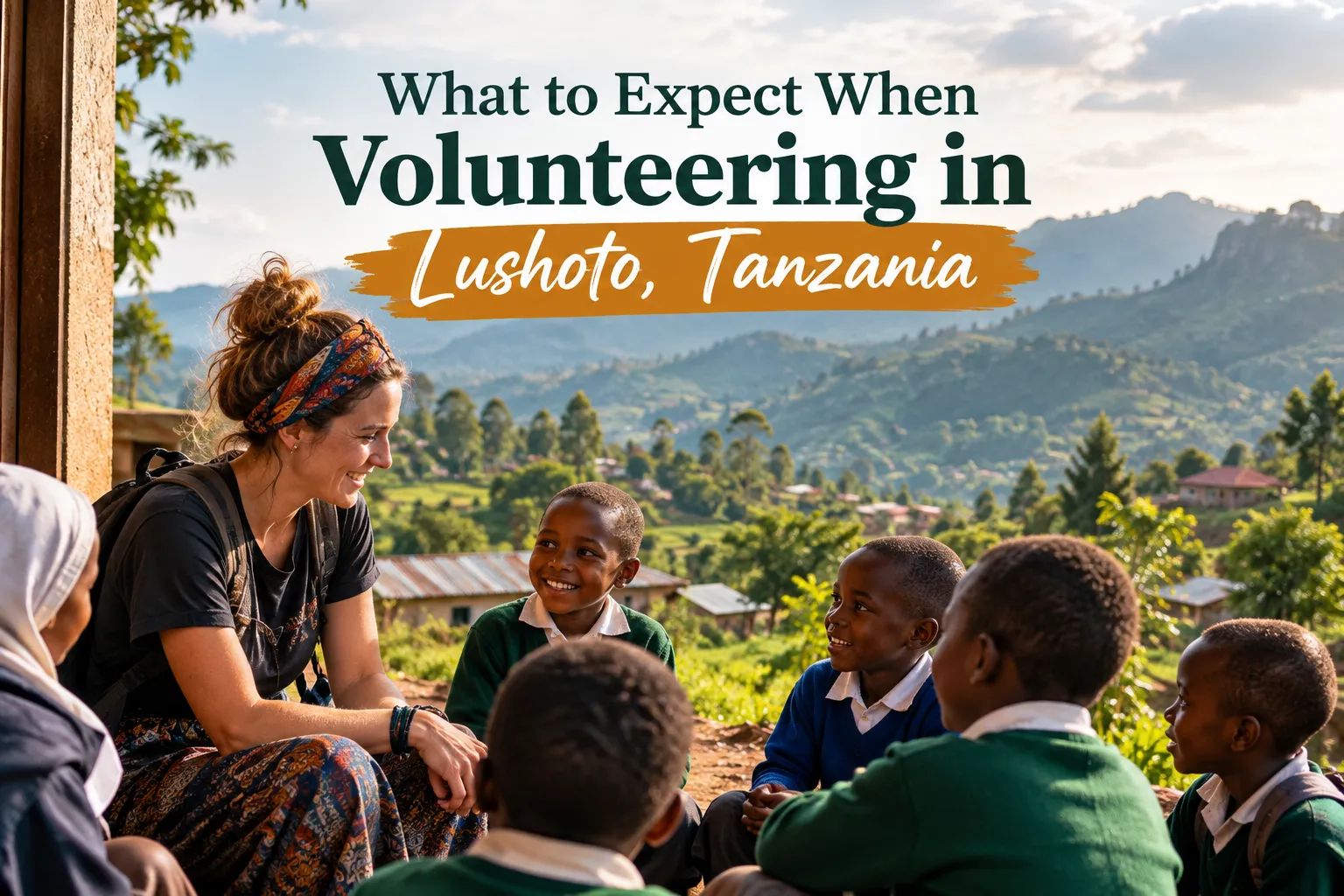
- Volunteer on the ground: Spend time in the Usambara Mountains, plant trees alongside Tanzanian youth, and see first-hand how community-led reforestation actually works. C.Y.D. O’s volunteer programmes welcome people of all backgrounds and ages.
- Partner with C.Y.D.O: Companies looking for credible, transparent carbon offset and CSR programmes in Africa can partner directly with C.Y.D.O on reforestation projects with full documentation and reporting.
- Share this story: Climate communication is itself climate action. Share this article. Tell people that Africa is not waiting to be saved — it is leading the way.
Frequently Asked Questions (FAQs)