Tanzania is losing its forests at an alarming rate. Over 400,000 hectares of forest disappear every year — taking with them biodiversity, water sources, and the livelihoods of millions. But communities across the country are fighting back, one native tree at a time. This guide will walk you through everything you need to know about planting native trees in Tanzania — from choosing the right species for your region to soil preparation, planting day, and keeping your trees alive for decades to come.
Not all trees are equal. While any tree provides shade and absorbs carbon, native trees — those that evolved in Tanzania’s specific ecosystems — offer something exotic species cannot: they belong here. They evolved alongside Tanzania’s wildlife, insects, soil microbes, and water systems over thousands of years.
When you plant an indigenous tree in the Usambara Mountains or along the Pangani River Basin, you are not just planting a tree. You are restoring a living relationship between soil, water, insects, birds, and communities that took millennia to build.
400,000+hectares lost/year in Tanzania
500,000+ native trees planted by C.Y.D.O
25+ communities supported through reforestation
Exotic trees like eucalyptus grow fast but drain soil water and support very little wildlife. Native trees grow more slowly but feed birds, protect insects, stabilise soil, and regenerate the micro-ecosystems that Tanzania’s communities depend on for food, medicine, and clean water.
Key insight: C.Y.D. O’s reforestation programs in the Pangani River Basin and Shagayu Forest Reserve specifically use indigenous species — because science and local knowledge both confirm that native trees are the only sustainable path to real forest restoration.
Step 1 — Choose the Right Native Tree Species for Your Region
Tanzania has over 10,000 known plant species. Choosing the wrong tree for your location is the number one reason community tree-planting projects fail. Here is how to choose correctly.
Native Species for the Usambara Mountains and Highlands
- African Olive (Olea africana): Extremely hardy, drought-tolerant, and supports local bird and insect species. Excellent for slopes and degraded hillsides.
- Peacock Flower (Erythrina abyssinica): Fast-growing, nitrogen-fixing, and used medicinally. Great for community boundaries and mixed woodlands.
- African Cherry (Prunus africana): Valuable timber and medicinal tree. Used by C.Y.D.O in Shagayu Forest Reserve restoration. Plant in cooler, higher-altitude zones.
- Wild Fig (Ficus species): Keystone species — over 1,000 animal species depend on figs for food. Plant wherever wildlife corridors are being restored.
Native Species for Tanga Coast and Lowland Areas
- Mangrove (Rhizophora mucronata): The coastal guardian. Protects shorelines from erosion, sequesters carbon at 3–5× the rate of terrestrial forests, and provides fish nurseries. Used in C.Y.D. O’s Indian Ocean Mangrove Planting project.
- African Mahogany (Khaya anthotheca): Valuable timber, strong canopy tree, excellent for reforestation of degraded coastal forests.
- Mkuyu (Ficus sycomorus): Beloved across Tanzania, supports vast wildlife communities and grows well in humid lowland conditions.
Fruit Trees for Schools and Communities
C.Y.D.O has planted over 5,200 fruit trees in Tanzanian schools — combining food security with environmental education. Recommended species for school and community planting include mango (Mangifera indica), avocado (Persea americana), papaya (Carica papaya), and jackfruit (Artocarpus heterophyllus).
Step 2 — Prepare the Soil Before You Plant Anything
Poor soil preparation is the second most common cause of tree planting failure. Tanzania’s soils vary hugely — from the rich volcanic soils of Kilimanjaro to the sandy coastal soils of Tanga. Here is a simple preparation process that works across most Tanzanian environments.
- Clear the planting area. Remove invasive grass species (especially Imperata cylindrica, known locally as nyasi), but leave leaf litter and organic material on the soil surface to protect soil microbes.
- Dig the right-sized hole. For most native tree seedlings, dig a hole that is 60cm wide and 60cm deep. This loosens the soil and gives young roots room to establish without compaction.
- Amend the soil if needed. In very sandy or very clay-heavy soils, mix the excavated soil with compost or well-rotted organic matter before refilling. Avoid chemical fertilisers for native species — they do not need them and excess nutrients can inhibit mycorrhizal relationships.
- Time you’re planting around rainfall. In Tanzania, the best planting windows are the onset of the long rains (March–April) and the short rains (October–November). Planting just before rain season means the tree’s most water-intensive establishment phase coincides with natural rainfall.
Pro tip from C.Y.D.O field teams: In the Usambara Mountains, our teams always mulch heavily around newly planted seedlings using dry grass and leaf litter. This retains soil moisture through dry spells, reduces watering requirements by up to 50%, and suppresses competing weeds during the critical first three months.
Step 3 — Plant Your Seedlings Correctly
Many tree-planting campaigns fail not because of the wrong species or poor soil, but because of incorrect planting techniques. Follow these steps for every seedling.
- Water the seedling before removing it from its container. A well-hydrated root ball holds together and suffers less transplant shock.
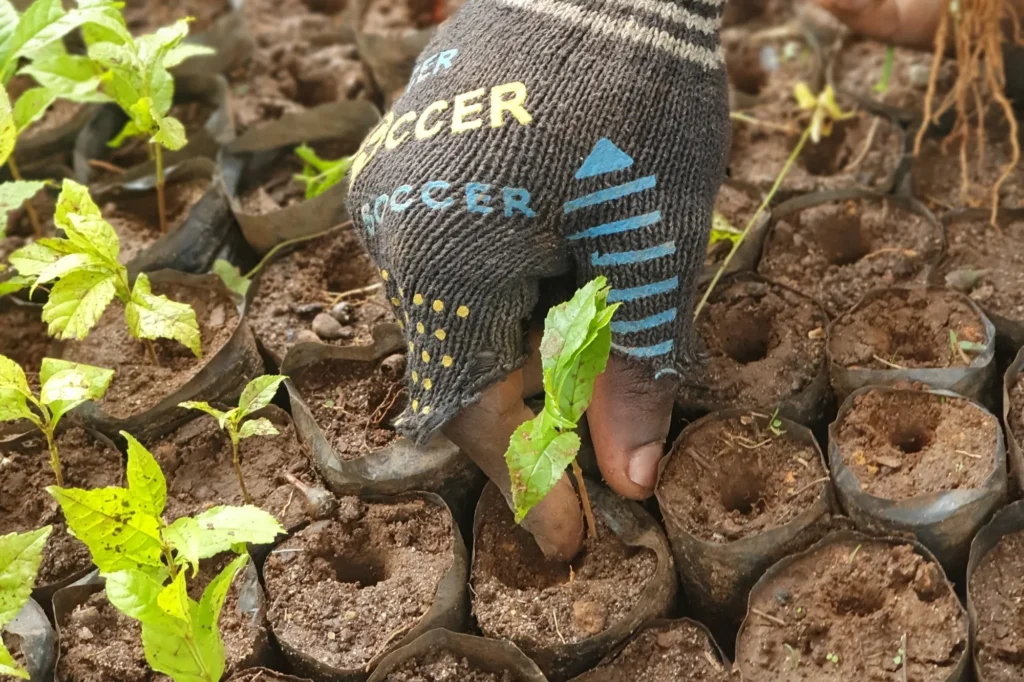
- Remove the container carefully. If using a plastic bag (polyethylene tube), cut it open rather than pulling — a torn root ball can set a tree back by months.
- Check the root ball for circling roots. Gently loosen any roots that have circled inside the container. If left, they will eventually strangle the tree’s own root system.
- Plant at the correct depth. The base of the trunk (the root collar, where the trunk meets the roots) should be at or just above the soil surface — never below it. Planting too deep is a leading cause of young tree death.
- Backfill firmly but gently. Fill the hole in layers, firming each layer with your hands (not your feet) to remove large air pockets without over-compacting.
- Water thoroughly immediately after planting. Give each newly planted tree at least 10 litres of water on planting day, poured slowly so it soaks in rather than running off.
- Stake if necessary. In exposed, windy sites, a simple stake on the windward side prevents the seedling from rocking in the soil before its roots establish. Remove the stake after 12 months.
Step 4 — Care for Your Trees in the First Three Years
The first three years are the most critical period in a tree’s life. During this time, the tree is establishing its root system and is most vulnerable to drought, competition, and browsing animals. Most tree deaths in community planting programs happen in the first dry season after planting — because aftercare is underestimated.
Watering Schedule
- Months 1–3: Water every 3–4 days if there is no rainfall. Use a slow pour of 10 liters per tree at the base — never splash water on the trunk or leaves.
- Months 4–12: Reduce to weekly watering during dry periods. By this point, established trees should be drawing moisture from deeper soil layers.
- Year 2–3: Water only during extended dry spells. A healthy, established native tree in Tanzania’s environment should be increasingly self-sufficient by the end of its second year.
Weeding and Mulching
Keep a one-metre weed-free zone around each tree for the first two years. Grass competes aggressively for water and nutrients. Maintain a 10cm layer of organic mulch (dried grass, leaf litter) within this zone at all times, keeping it away from direct contact with the trunk to prevent rot.
Protecting Against Browsing Animals
In many Tanzanian communities, goats, cattle, and other livestock are a major cause of young tree loss. Simple thorn-branch enclosures around individual trees or planting sites cost almost nothing and can double survival rates. C.Y.D. O’s teams routinely use locally sourced thorn branches as protective barriers in the field.
🌿 From C.Y.D. O’s Field: The Pangani River Project
In 2022, C.Y.D. O’s field teams began planting along the degraded banks of the Pangani River Basin — one of Tanzania’s most critically threatened water systems. Using exclusively indigenous species, including Riparian Figs, African Mahogany, and Riverine Acacia, over 500,000 trees have now been planted across the basin. Communities living alongside the river have reported visibly improved water levels in small streams during dry seasons — a direct result of restored tree cover stabilizing the watershed. Every tree is GPS-recorded and monitored for survival rates.
Step 5 — Track, Monitor, and Celebrate Progress
A tree planting project without monitoring is a tree planting event — not a reforestation programme. Monitoring transforms planting days into long-term ecological restoration.
- Record every tree planted — species, location (GPS if possible), date, and who planted it. C.Y.D.O records GPS coordinates for every tree in its major projects.
- Conduct survival counts at 3, 6, and 12 months. A healthy project should have 70%+ survival at 12 months. If survival is lower, investigate the cause before the next planting season.
- Replace dead trees promptly — ideally within the same rainy season. Leaving gaps reduces the canopy closure that benefits surrounding trees.
- Celebrate and document milestones — 1,000 trees, one year of growth, first fruiting, first wildlife sighting. Communities that feel proud of their forests protect them.
How Communities Across Tanzania Are Leading the Way
The most successful reforestation projects in Tanzania are not led by outside organisations — they are led by local communities who understand their land, their water, and their forests better than anyone else. C.Y.D. O’s approach has always been to provide training, seedlings, technical support, and resources, while community members provide the knowledge, the labour, and the long-term stewardship.
In Lushoto and across the Tanga region, C.Y.D.O has trained hundreds of young people as community tree nursery managers, restoration technicians, and environmental educators. These young Tanzanians are not just planting trees — they are building careers, protecting their water supplies, and creating forests that will serve their communities for generations.
Frequently Asked Questions About Planting Native Trees in Tanzani